
Are you running out of cash?

OLYMPUS DIGITAL CAMERA

Managing cash flow is a problem faced by businesses of all sizes, particularly those on a strong growth path or with large value orders.  June is the best time to take a breath, sit down and plot out your cash flow requirements for the new financial year.  A little planning now could save you time and money.

The worst time to try and borrow cash is when you are desperate for it.  Effectively, you have no negotiating power and are stuck in the position of having to complete make or break deals.

The impact of time

A lot of people get profit and cash flow confused.  And that’s why you may have asked your accountant or yourself that question, “If I’m making all this profit where is it?”

One part of the answer is the timing impact that occurs in most businesses between when the profits are made and when the cash is required to meet day-to-day operating.

Let’s have a quick look at some of the areas of your business where there are timing impacts:

  • You decide to supply some of your customers on credit and so you open a number of credit accounts. The sales you make this month are not paid for until the end of the following month. Immediately, you have created a 30-60 day timing difference between your sales (creating the profit) and the receipt of the payment (your cash flow).
  • Your sales have some seasonal fluctuations such as Christmas time. In order to have your stock on the shelves when you need it you need to purchase it two months before the start of the sale period. Your suppliers give you 30 day credit terms. Even allowing for this, you probably have your money tied up in the stock about 45 days after you have paid your suppliers. And if for any reason you don’t sell all of the purchased stock then you will be funding it for a longer time period.
  • Your rent on your premises is paid monthly and in advance. So even before you have made any sales and earned any profit you need to outlay some of your monthly operating costs.

By understanding that the timing of your cash flow could be quite different to your business trading you will recognise the need to plan for the movements in your cash flow.

The only solution here is to find out where things are really up to and then see if the business can be put back on track in a reasonable time frame.

Craig and Karen may need to look at some additional funding. This could include specific funding to cover the fitout of the new stores that were paid for out of working capital.  They may also need to have a talk to the ATO and work out a payment program to bring things up to date. This is something they need to review with their adviser.  Most of all they need to get a strong accounting system in place and a good management information system.  If they don’t their empire will quickly be at risk.

The do’s and don’ts of cash flow management

Do:

  • Have sufficient capital in place to start your business and manage its growth
  • Keep track of where you are up to on a weekly basis
  • Control your debtors and stock. They’re good to have but they need to keep turning over into cash
  • Keep up to date cash flow budgets and management information systems
  • Match your borrowings to the asset life they are funding – long term assets need long term borrowings
  • Always allow for your tax debts. Under the GST business tends to collect a lot more tax than it previously used to
  • Look at your funding options. There may be more ways to manage your position than you think

Don’t:

  • Take your eye off your cash flow. It wont manage itself
  • Don’t simply rely on your bank balance to know where you are up to
  • Risk credit on bad credit risks. Have limits and controls in place
  • Get caught over trading. You can only afford to grow to the extent that you can finance
  • Pay for today’s expenses with tomorrow’s sales. You need adequate capital

Completing your cash flow plan

The key to cash flow planning is to:

  • Identify where the money comes from in your business; and
  • When you can expect it to arrive.

Once you have done this write down all of the months of the year and start to plot out how much money will arrive in each month and where it will come from.  To do this you need to:

  1. Identify any money you are planning to invest in your business over the coming year
  2. Know if you are planning to borrow any money
  3. Estimate your sales for the coming year
  4. Work out how long it will take for your customers to pay you
  5. Identify any other money that is likely to come in to the business and when

For assistance with your cash flow planning contact either myself, John or Sam, today.

Or call:

Brisbane: 07 3421 3421
Noosa Heads & Maroochydore: 07 5474 8955

Kind regards,

Rob McAdam
Partner

Please note: The material and contents provided in this publication are informative in nature only.  It is not intended to be advice and you should not act specifically on the basis of this information alone.  If expert assistance is required, professional advice should be obtained.
Accelerate your cashflow

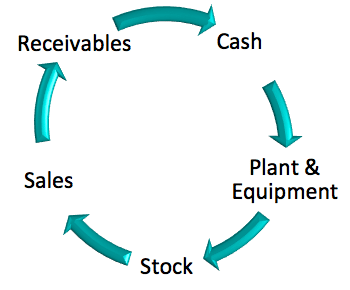
In a typical business your cash cycle looks something like this.

Accelerate your cashflow diagram

While this can vary slightly from business to business the difference would usually only be in the addition or subtraction of one piece of this cycle. In our model you start your business by investing cash, firstly in your plant and equipment, and then into stock. Next you make some sales, converting your stock into debtors. Once you are paid by your debtors it turns back into cash and the cycle begins again.

The more you can accelerate your cash cycle the faster you turn your profits into cash and the easier it is to manage your liquidity position.

Here are some tips to manage cash flow:

  • Plant & Equipment – don’t have too much money tied up here. Avoid surplus plant and don’t invest in plant that is significantly in excess of your capacity requirements. Sometimes it is a good idea to lease plant rather than having a lot of your capital tied up in this area. If you have surplus plant to your requirements consider selling it and turning the asset back into cash.
  • Stock – be careful about how much capital you have tied up in stock. Generally the more times you can turn your stock over in a year the more efficient and profitable you will be. Also avoid holding obsolete or slow moving stock. You should be aiming to have your stock levels as low as possible without impacting on the efficiency of your business.
  • Debtors – this is an area where lots of businesses have their cash tied up. You need to be on constant alert here and really police this area. Once you have agreed trading terms with a customer, ensure they stay within them. If you allow them to drift out not only are you incurring additional costs but you are also risking a bad debt – and that can really be costly to your business.

Here are a few ideas to help accelerate your cash flow cycle:

  • Buy stock on a consignment basis
  • Arrange with your suppliers to hold stock for you with the capability to deliver within a day or so of order
  • Keep good records on your stock position so you know exactly when you need to order replacement stock
  • If you have seasonal stock then be prepared to adjust your price toward the end of the season to avoid having to hold over the surplus stock
  • Unless there are significant quantity discounts for buying volume stock only purchase what you know you will need within the immediate future
  • Encourage customers to pay cash on delivery (COD) rather than operate on an account
  • Offer settlement discounts for account customers who will pay you within seven days
  • Avoid opening accounts for small customers or those who only buy from you on an occasional basis
  • Allow your customers to buy from you using their credit card
  • Always issue your invoice immediately on completion of the job
  • Be prepared to stop supply if a customer does not pay you within agreed trading terms
  • Always complete credit checks when you are opening new customer accounts

Call or Contact us us if you would like some more information.

Brisbane: 07 3421 3421 (Rob & Sam)

Sunshine Coast: 07 54748955 (John)


Why discounting can be a dirty word

Post-Three-Dirty-Words

The single most overused marketing strategy to bring customers through the door is discounting.

While this can be an effective strategy, for some businesses it generates a price war that they cannot afford to sustain.

Take the entrance of a new retailer in a shopping centre.  They specialise in one type of product that is also sold as part of the range of a major retailer also located in the shopping centre.  The new retailer opens at a discount to attract customers into the shop.  The major retailer not only matches but further discounts to prevent loosing customers.  For many, this is the start of a pricing war that the small retailer is unlikely to win.

Then there is the example of a business where the volume of sales drops off.  The automatic response is to drop the price of the stock to attract customers.

There is nothing wrong with discounting strategies if that’s what fits your business.  If you are using it as a strategy to bring in cash flow – be careful. If you don’t understand its effect then you can cause a disaster in your business and its profitability.  This is because discounting creates a leverage impact on profits.  Essentially by discounting you are giving some or all of profits away.  The key is to understand the impact and just how far you can go.

Consider the following example – a business with a 30% gross profit margin who offers a 25% discount (certainly nothing unusual about that in today’s market) requires a 500% increase in sales volume just to maintain its same position – and in almost all cases that’s just not going to happen.  The result generally is the business trading below its break even point and generating losses.

While discounting can be a short term strategy it should be used carefully and with as part of an overall marketing strategy.

Call or Contact us us if you would like some more information.

Brisbane: 07 3421 3421 (Rob & Sam)

Sunshine Coast: 07 54748955 (John)


Rob starts Kokoda Trail

The Kokoda Trail (96km) is one of the world’s great treks.
Challenging!
Educational and

Liberating!

It is rated the hardest sea level walk in the world and I now know why.

Kokoda

You measure the days in number of hours up or down not the kilometres walked.Each day presents it’s own challenges both physically and mentally.Having walked the track over 8 days, from Kokoda to Owens Gate, I would rate it the hardest challenge I have attempted.

I was with a group of 6 other trekkers and our fearless team leader (Dan). While we did not know each other at the beginning, by the end of the trek we were a close team prepared to help each other on the track, share a story and laugh at the end of a hard days walking, and listen with awe at the story of the WW2 battle as told by our leader.

If at any time you felt tired or sorry for yourself, we all just remembered what the diggers and Fuzzy Wuzzy Angels dealt with in WW2.

Otti my Porter, was a 20 year old local who probably weighed slightly more than my 2 legs combined, and he did not leave my side the whole trip, saving me from countless falls in the slippy  and uneven ground.

He has walked the track 4 times.

The porter and locals are an amazing group of people, very quite, happy and we were treated

to their beautiful singing at night.

The highlights of the trip for me were:

My fellow trekkers and the porters

The amazing country we walked through

The service we held at Brigade Hill were approximately 45 diggers died in a battle to hold their position against over whelming odds;

Meeting the last living Fuzzy Wuzzy Angel and seeing Dan stand to attention and salute him.


I came off the track 6kg lighter but in awe of what the diggers had done those many years ago.

Would I do it again – unlikely

Was it worth it – every step up and every step down.


Do you own a residential or commercial investment property?

If so, are you claiming all the tax deductions that you are entitled to?

In a recent article (Issue 36, 2014) published by BMT Tax Quantity Surveyors and a recent release by the tax department, that2.5m property investors claimed deductions relating to their rental property in the 2011 – 2012 income year.

Of these, just over 1 million claimed an average capital works deduction of $2,029; whilst just over 1.7 million claimed an average deduction for plant and equipment of $1,139.

Based on their data from the BMT Tax depreciation schedules, the average claim in the first year is $10,100, and then $7,350 per year on average over the first 10 years of owning a property.

When we are preparing your tax returns and you have a rental property, we will be checking that you are firstly able to claim a capital works deduction (building) or plant and equipment depreciation (hot water system, carpets).

If nothing has been claimed previously in your returns, we will discuss your options.

BMT deduction assessment
Purchase price First year deductions Five year cumulative Average annual cash return*
New unit $450,000 $12,800 $55,040 $4,073
Old unit (1970) $450,000 $6,900 $28,980 $2,145
New 3 BR house $600,000 $11,200 $48,160 $3,564
Old 3 BR house (1970) $500,000 $6,000 $25,200 $1,865

Significant deductions are usually available despite a property’s age.

*(First five years, calculated on a 37% tax rate).

The average annual cash return will vary depending on your tax rate in a particular year.

When we are preparing your tax returns and you have a rental property we will be checking that you are firstly able to claim a capital works deduction (building)or plant and equipment deprecation (hot water system, carpets), and if nothing has been claimed previously discussing your options.

Call or Contact us us if you would like some more information.

Brisbane: 07 3421 3421 (Rob & Sam)

Sunshine Coast: 07 54748955 (John)c


Are you interested in Self Managed Super Funds (SMSF’s)?

Our licensee, SMSF Advice, is a subsidiary of the AMP Group and in partnering with them we are able to draw on in-depth knowledge of the financial services industry. We can leverage a wide range of plans, tools and training to ensure we deliver the best possible .

Visit: http://www.smartchoicesmsfadmin.com.au

4 key tools for successful business management

tools

These are the four things every business should have!

Operating budget

You need to know what the year is going to look like. How much profit you will make, when you will be making your profit and how your income and expenses are likely to move about. Without this you will be under prepared for the year and need to manage by gut instinct or reaction to events as they occur. Get your budgets in place and then you can track performance against expectation.

Capital expenditure budget

This is about understanding and identifying how much you are likely to need for capital purchases throughout the year. This might be replacements or new plant or equipment required because of business growth or change.  Most businesses have capital expenditure requirements but many don’t plan for them.  When they occur they can disrupt your cash flow. Plan ahead. They are an essential part of your cash flow budget.

Cash flow budget

You absolutely need this. Cash is king and there is plenty of evidence that the Australian Taxation Office and large suppliers are taking a tougher approach on collections. Your cash flow budget needs to flow on from your operating and capital expenditure budgets.  You need to forecast the timing of money flowing in and out of the business.  Make sure you include things like tax payments, loan repayments and dividends.  And, plan around the cycles that can occur with BAS payments. If you are going to be tight for cash at some time in the year, talk to your bank early up.

KPIs (Key Performance Indicators)

These are a great way to manage the business. What are the key indicators that show your business is on track? It might be the number of enquiries, machine hours for a production business, on time delivery, customer complaints, or staff turnover. For most businesses you can measure performance around six KPIs. They are the key influencers of your business’s operating performance and should be capable of being easily tracked and managed. If you haven’t used them before give it a try.

For assistance to get your business running at its strategic best this financial year, please contact either myself, John or Sam today to arrange a time for us to work with you on your business’s budget and KPI planning.

Sincerely,
Rob McAdam
Partner

Does your business measure up?

Tape-measure-300x224

Knowing where your business is up to day to day is an essential piece of management information. Too many business owners get caught out believing that their business is doing ok or getting by, only to find out that the reality is a different story.

Good measurement systems are not difficult to establish and the start of the financial year is a good time to put in place or fine tune your existing systems to deliver reliable and useful information.  Where it gets hard is when you are trying to play catch up, finding out where all the pieces are and trying to build them into your system when you need them. Your measurement systems need to provide you with both financial tracking and management information.

Here are the key elements of a good system:

  • Operating budgets and cash flow forecasts to map out what you expect to happen over the coming year.
  • Track your actual position and measure it against your expectations. To achieve this you need to have in place an accounting system that tracks your operating performance and tells you whether you are making profits or losses.
  • Track your cash flow position. The maturity of your business and its growth cycle will determine how often you need to track information.For example, in a start up business or a business growing quickly, the general rule is to track cash daily and profits monthly.

Once your systems are in place to track the numbers the key then is to know what to look for.   Don’t fall into the trap of tracking the numbers in absolute terms. You should be tracking them against your expectations. As an example, it is not uncommon for a high growth business to make losses and have negative cash flow.  These results are not necessarily bad news.  If they are following the forecasts that you previously signed off on, then this is ok.  What you are looking for is variance from the forecasts and trends against forecasts.  You need to be concerned where there are significant adverse departures from your forecasts.

From a financial perspective these systems will provide a foundation level of information; but what about some effective business or management information?

Every business should be managed around some key performance indicators (KPIs). These provide fast and reliable guides on business performance.  As an example, if you are a retailer you can reliably predict business performance around customer traffic and conversion rates. So a KPI for you could be the number of people coming into the shop each day and the conversion rate on those customers.

The strength of KPIs is that they are easy to access, reliable in their predictive results and can be produced in quick time. They give you instant access to what is happening in your business.

Most SME businesses can be tracked and managed effectively on six KPIs.  More doesn’t mean better.  The key is to identify the areas of your business which are most likely to impact business performance.  So, a part of the question is what are the key fundamentals to your business? What are the key business drivers and what are your critical success factors? Work through these and the KPIs will quickly identify themselves.

Once you have your financial management system in place and your business performance measurement system in place you have access to both financial and non financial information that will not only tell you where your business is up to but where it is heading.  This type of information separates businesses that are well managed from those that hope they will make it.

For advice and assistance on managing your information systems, contact us today.